
Chief Oscar Presley Jr.
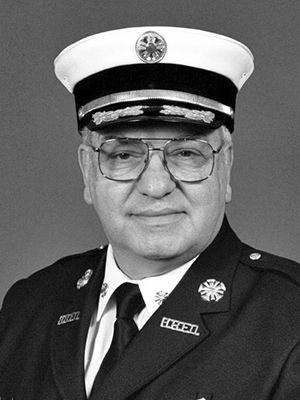
Oscar L. Presley Jr. dedicated more than four decades of service to the Harlem-Roscoe Fire Protection District, serving 42 years with the department, including 25 years as Fire Chief. He joined the department on January 10, 1966, recalling, "I was asked by Captain John Weldon if I would stand by the day of Chief Howard Rogers' funeral, and two weeks later they swore me in as a volunteer."
On December 27, 1982, Oscar became the department's seventh Fire Chief. On December 1, 1996, he made history as the District's first full-time paid Fire Chief, ushering in a new era of professional leadership. Outside of the fire service, Oscar owned barbershops in Roscoe and Rockton, working as a barber for 35 years. He also served as Roscoe Township Road Commissioner for 10 years, was an active member of the Roscoe Lions Club, a founding member of the Winnebago County E-911 Board, and a dedicated member and Past President of the Winnebago Fire Chiefs Association. Continuing the family's tradition of service, his son, John Presley, also became a member of the department.
Chief Presley transformed the organization into a modern emergency services agency by implementing structured organizational plans, developing policies and job descriptions, and introducing business-minded management practices. He was the department's first chief to use a dedicated command vehicle after one was donated to the District. He also championed the installation of visible address markers throughout the community, recognizing their importance in reducing emergency response times.
A visionary in emergency medical services, Oscar helped pioneer the department's volunteer paramedic program in 1979 and personally served as a paramedic for 20 years. He played a key role in fundraising efforts that purchased the department's 1973 rescue squad and later its first trauma unit. He also helped establish around-the-clock staffing of two paramedics, significantly enhancing emergency medical care for the community.
Throughout his tenure, Chief Presley oversaw some of the most significant milestones in the District's history. He directed the construction and relocation of Station One to its current site, managed expansions to both Stations One and Two, secured donated property for Station Three, and oversaw its construction. One of his greatest accomplishments was realizing his long-held vision of a dedicated firefighter training center behind Station Three. In recognition of his leadership and commitment to firefighter education, the facility was dedicated as the Oscar L. Presley Jr. Training Facility in 2004.
Oscar understood the importance of preserving the department's history. Rarely without a camera in his pocket, he documented fires, emergencies, training events, and department milestones, believing that every moment was part of the organization's legacy. He also established the role of department photographer to ensure those memories would continue to be preserved. Today, a recorded interview with Chief Presley is archived at the North Suburban Library in Roscoe, preserving his firsthand account of the department's history for future generations.
Chief Presley's service was recognized with numerous honors throughout his career. The Village of Roscoe dedicated a day in his honor, planted a commemorative tree in Leland Park, and renamed Elm Street as Presley Place in recognition of his lasting contributions. He received the Paramedic of the Year Award in 1980, the Harlem-Roscoe Fire Protection District Meritorious Service Award in 1999 and 2003, and the Illinois Veterans of Foreign Wars Outstanding Firefighter Award. Following his retirement on December 31, 2007, he received one of the highest honors in the fire service when the Illinois Fire Chiefs Association presented him with the Fire Chief Emeritus Award on October 21, 2008.
By the time Chief Presley retired, the Harlem-Roscoe Fire Protection District had grown to include three fire stations, 30 pieces of emergency apparatus, and a highly respected combination fire and EMS organization. His leadership, vision, and unwavering dedication fundamentally shaped the modern department and established a legacy that continues to benefit the community today.
Chief Presley often summed up his philosophy with a simple belief: "Nearly anything is possible if you set your mind to it."